M1 · Understanding Homelessness
M1
Slide 17
COMPARISON
Approaches to Addressing Homelessness: Staircase Model vs. Housing First
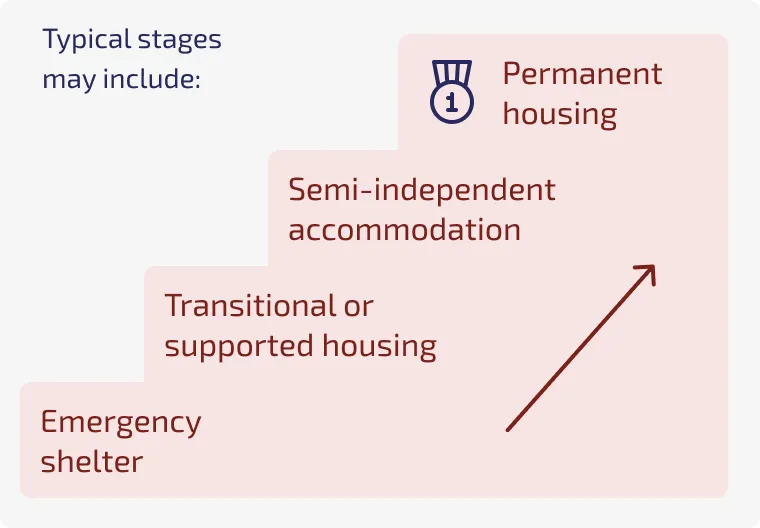
Responses to homelessness are shaped by underlying assumptions about responsibility, readiness, and the role of housing in recovery. Two dominant approaches have emerged in European and international practice: the staircase model (often called Treatment First) and the Housing First model. Understanding their differences is essential for evaluating policy effectiveness and designing integrated systems of care.
STAIRCASE MODEL (Treatment First)
Based on gradual progression. Individuals move step by step through different levels of accommodation before accessing permanent housing.
Housing is viewed as a reward for stability.

STAIRCASE MODEL

Progression is usually conditional. Individuals are expected to demonstrate “readiness”, often defined as:

Abstinence from substance use

Compliance with treatment

Behavioural stability

Engagement with services

Underlying Assumptions
The staircase model assumes that personal rehabilitation must precede housing stability. It treats homelessness as a problem that must be corrected before permanent housing can be sustained.
Limitations
Research and practice have identified several challenges:

High dropout rates between stages

Prolonged stays in temporary accommodation

Recurrent returns to emergency shelters

Administrative complexity

Fragmented service delivery

Conditional access may unintentionally exclude individuals with complex needs — precisely those most vulnerable to chronic homelessness.
HOUSING FIRST
Reverses the logic. Individuals are provided with immediate access to permanent housing without preconditions such as abstinence or treatment compliance.
Housing is a precondition for recovery, not a reward for it.

HOUSING FIRST

Support services are:

Voluntary

Flexible

Multidisciplinary

Long-term if needed

Housing First is built on principles of:

Housing as a human right

Client choice and autonomy

Harm reduction

Integrated support

Evidence and Outcomes
Evaluations across multiple countries demonstrate:

High housing retention rates (often above 80%)

Reduced emergency healthcare utilisation

Improved mental health stability

Lower rates of re-homelessness

Increased cost-effectiveness in long-term analyses

Housing First does not ignore addiction or mental illness. Instead, it stabilises housing first, allowing health and social interventions to be more effective.
Comparing the Two Models
STAIRCASE

Housing is conditional

Readiness required

Stepwise progression

Compliance-based

Often time-limited support

HOUSING FIRST

Housing is unconditional

Readiness supported

Immediate permanent housing

Choice-based

Flexible, long-term support

The core difference · Sequencing
STAIRCASE
Stability → Housing
HOUSING FIRST
Housing → Stability
Implications for Integrated Health and Social Care
From an IHSC perspective, Housing First aligns more closely with integrated care principles:

It reduces fragmentation by stabilising one core determinant: housing.

It enables coordinated health and social interventions.

It shifts focus from managing homelessness to ending it.

However, implementation requires

Cross-sector collaboration

Sustainable funding

Political commitment

Availability of affordable housing

No model operates in isolation from structural conditions. Where affordable housing supply is insufficient, even Housing First faces limitations.
Critical Reflection

Does the system require individuals to prove worthiness?

Does it address structural causes or focus primarily on behaviour?

Does it reduce or reinforce fragmentation?

Effective responses to homelessness require more than temporary accommodation. They require structural alignment between housing policy, social protection and healthcare systems.
Housing models are not merely technical tools — they reflect societal values about responsibility, dignity and rights.