M2
Slide 13
CONTENT
Trimorbidity and Clinical Complexity
When three crises overlap
Trimorbidity refers to the co-occurrence of physical illness, mental illness and substance use disorder. It is common in homeless populations — and it is the point at which single-disease healthcare systems fail most clearly.
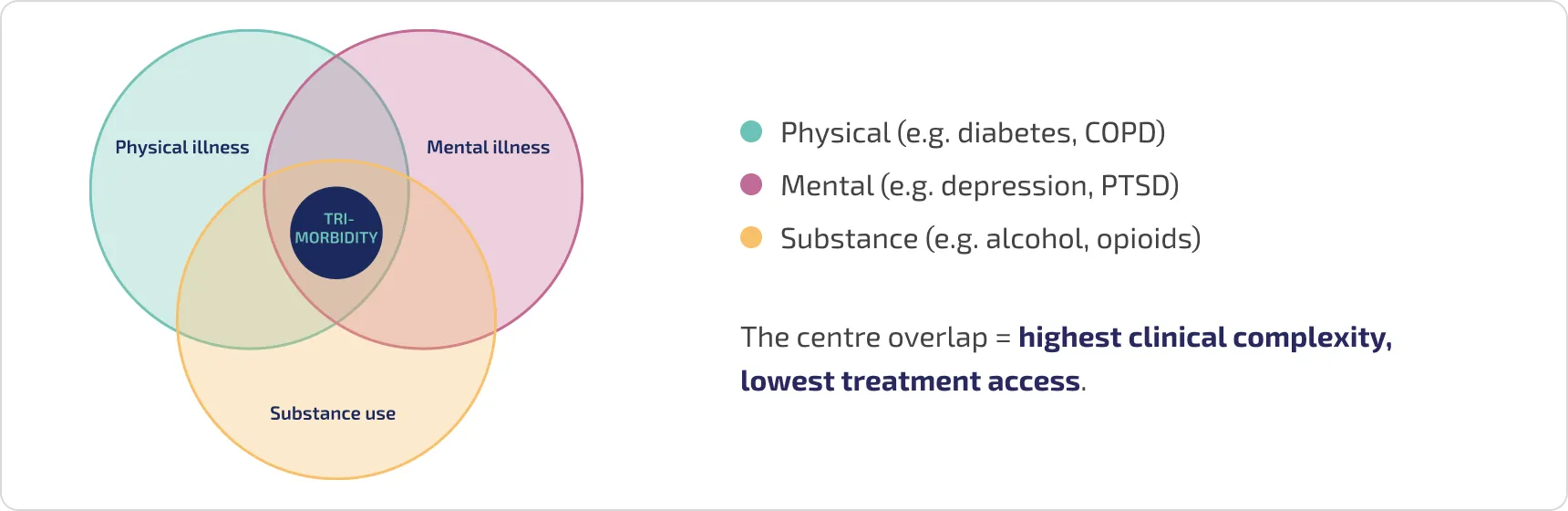
This combination creates:
Increased risk of emergency hospital use
Greater treatment complexity
Lower adherence
Higher mortality
Increased care fragmentation
EXAMPLE
A patient with diabetes (physical illness), major depression (mental illness), and alcohol dependence (substance use disorder) faces multiple overlapping treatment requirements that are difficult to coordinate without stable housing and integrated care.
Intersectionality and Compounded Vulnerability
Mental illness and substance use cannot be separated from structural determinants. Factors such as:
Poverty
Criminalisation
Prior imprisonment
Migration status
Discrimination
Low education
intersect and amplify vulnerability.
Intersectionality theory helps explain how overlapping disadvantages create unique and intensified health risks.
Barriers to Treatment for Mental Health and Addiction
People experiencing homelessness face specific barriers when seeking help for mental health or addiction:
Strict abstinence requirements in shelters
Long waiting lists for psychiatric services
Administrative documentation requirements
Lack of integrated dual-diagnosis treatment
Distrust of services
Many individuals prioritise immediate survival needs (food, shelter, safety) over long-term recovery. This creates a cycle:
Homelessness
Substance use
Further exclusion
Worsened health
Increased instability
Harm Reduction and Integrated Response
Harm reduction approaches acknowledge that abstinence is not always immediately achievable.
Examples include:
Needle and syringe exchange programmes
Opioid substitution therapy (methadone, buprenorphine)
Naloxone distribution
Managed alcohol programmes
Safe consumption spaces
These programmes aim to reduce health harms and mortality rather than enforce abstinence as a precondition for care.
Evidence suggests that combining housing stability with harm reduction improves outcomes.
Implications for Integrated Health and Social Care
Mental health and substance use cannot be treated in isolation from housing instability. Effective responses require:
Multidisciplinary teams
Continuity of care
Trauma-informed practice
Low-threshold access
Integration of psychiatric and primary care
Coordination with housing services
Fragmented systems disproportionately harm people with trimorbidity.
Integrated models reduce emergency use, improve adherence, and support long-term stabilisation.
CORE INSIGHT
Mental illness and substance use among homeless populations are not marginal issues — they are central to understanding health vulnerability.
Without integrated, person-centred, and housing-stabilised approaches, treatment outcomes remain limited.